
|
|
|
|
|
Kŗṣṇajanmāṣṭamī also popularly known as Kŗṣṇāṣṭamī (कृष्णाष्टमी ) or śrīkŗṣṇajayantī (श्रीकृष्णजयन्ती) celebrates the birth of the eighth incarnation of Lord Viṣṇu (विष्णु). The festival is celebrated on the eighth day (अष्टमी तिथौ) of the dark fortnight (कृष्णपक्षे) in the month of Bhādrapada (भाद्रपद-मासे). The festival is celebrated with great pomp in unique ways all across the country. While in some places the home is decorated with small footprints made of flour in other places, groups of men create pyramids and attempt to break a high-reaching pot of curds. Each of these acts symbolize the various mischevious acts of Lord Kŗṣṇa. In fact, the childhood stories of Kŗṣṇa (meaning "dark", "black" and "all attractive") depict several interesting, engaging and exciting acts of the Lord.
"Kŗṣṇa" means the dark one or the all attractive-one. The stories of Lord Kŗṣṇa are enticing, magical and spiritual. They arouse various emotions in the listener. In addition, they inculcate great devotion.
Kŗṣṇa is believed to be the eighth incarnation of Lord Viṣṇu. Out of all the incarnations He is considred a complete incarnation or the "Pūrṇa-avatāra".
The following stories of Kŗṣṇa are taken from the Viṣṇu-purāṇa, Bhāgavatam and Mahābhārata.
|
स्वसुर्वधान्निववृते
|
svasurvadhānnivavṛte
|
|
Having understood that those words (of Vasudeva) were correct, Kaṃsa refrained from slaying his sister. Even Vasudeva was pleased with Kamsa's calmness. And he entered his own house. |
|
Kaṃsa (कंस) was the King of Mathurā (मथुरा ) - sometimes also referred to as City of Madhurā (मधुरा). He had a sister Devakī (देवकी) whom he loved dearly. After Devakī's marriage, Kaṃsa drove his sister and his brother-in-law Vasudeva (वसुदेव). As he drove the chariot, he heard a voice from heavens that the eighth child of Devakī would kill him. Filled with anger, Kaṃsa took out his sword to kill Devakī. Vasudeva stopped him and said that since it was the eighth child of Devakī that would kill Kaṃsa, he should let his sister free. He promised to hand over their eighth child to Kaṃsa. But, Kaṃsa would not trust them and he imprisoned both Devakī and Vasudeva.
|
नन्द-व्रजं शौरिः उपेत्य तत्र तान्
|
nanda-vrajaṃ śauriḥ upetya tatra tān
|
|
The brave one (Vasudeva) reached the place of Nanda where all the cowherds resided. There he found all those cowherds lying down from sleep.
|
|
At midnight, on the eighth day in the month of śrāvaṇa, Devakī begot her eighth child in the dark prison. It was a stormy night. Vasudeva was shocked to see that the prison doors were open and the guards were fast asleep. Seeking this as a great opportunity, Vasudeva placed the baby in a casket and stealthily walked out of the prison. As he walked by even River Yamunā (यमुना नदी) made way to ensure the baby's safety. Vasudeva crossed the river and reached Gokul. There he left the baby in the home of Nanda (the king of the cowherd community) and Yaśodā.
|
नाहं भक्षितवान् अम्ब
|
nāhaṃ bhakṣitavān amba
|
|
O Mother! I did not eat (the butter). They are all false accusations.
|
|
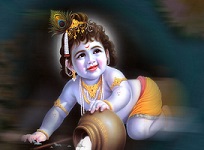
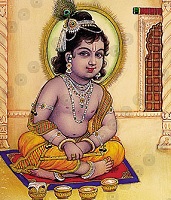
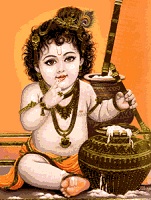
Kŗṣṇa was a very mischevious child. He was very fond of butter and milk. Yaśodā tried to hide the butter jars high up in the ceiling but Kŗṣṇa with his friends would form a human pyramid. Kŗṣṇa would climb on top of his friends and steal the butter. They would also visit the homes of other cowherd women and steal milk and butter when they were not around.
The other cowherd women constantly complained to Yaśodā. Tired of the complaints, Yaśodā got a long rope and tied Kŗṣṇa to a big heavy mortar. Kŗṣṇa dragged the mortar and started to move. The mortar got stuck between two trees. Kŗṣṇa continued to pull the mortar and the two trees fell down with a heavy thud. Hearing the thud everyone came out and were wonderstruck to see the feat of little Kŗṣṇa. The two trees were the cursed sons of Kubera, the God of wealth. They were Maṇigrīva and Nalakubera who were cursed by sage Nārada to become trees. Nārada also predicted that only Kŗṣṇa would be able to liberate them from their sin.
Once, Kŗṣṇa's friends complained to mother Yaśodā that Kŗṣṇa was eating mud. Angered by that, mother Yaśodā asked Kŗṣṇa to open his mouth. To her amazement, Yaśodā saw the entire universe in the mouth of little Kŗṣṇa. Yaśodā realized that Kŗṣṇa was none other than the Almighty himself and hugged her little boy with great love and affection.
|
एवं परिभ्रम-हतौजसम् उन्नतांसम्
|
evaṃ paribhrama-hataujasam unnatāṃsam
|
|
In this way having He bent Kāliya's raised shoulders. These shoulders had lost their strength due to the jumping around (by Lord Kṛṣṇa). Kṛṣṇa, the origin of all was ascended on those broad heads.
|
|
Once a huge poisonous black serpent called Kāliya entered the river Yamunā. Kāliya had so much venom that it poisoned all the waters of River Yamunā. The people became afraid and their cows started dying as they drank the waters from the river. Kŗṣṇa decided to teach Kāliya a lesson. He jumped into the river and attacked Kāliya. The serpent was furious and tried to coil around Kŗṣṇa to kill him. But, Kŗṣṇa challenged the serpent, jumped on it and stamped its head till the serpent spat out all the poison. Kāliya begged for forgiveness and promised to leave the river. Kŗṣṇa came out of the river dancing on Kāliya. The people were shocked and rejoiced seeing the amazing feat of little Kŗṣṇa.
|
इत्युक्त्वैकेन हस्तेन
|
ityuktvaikena hastena
|
|
Having spoken thus, Lord Kṛṣṇa, who is an incarnation of Viṣṇu, carried the moutain in one hand.
|
|
Kŗṣṇa was growing up in Vŗndāvan. And the people of Vŗndāvan worshipped Indra, the God of Rain. Kŗṣṇa asked everybody to worship the Goverdhana mountain instead. He said that the mountain supported forests and grass which helped the cows and in turn the livelihood of everybody. So, everyone started to worship Goverdhana. Indra became furious. Using his powers he brought heavy rains in Vŗndāvan. Everybody became afraid. But Kŗṣṇa asked everyone not to fear and said that Goverdhan would help them. Kŗṣṇa lifted the mountain with his little finger. The mountain seemed like a huge umbrella and everybody took shelter there. After seven days, Indra realized his folly and became ashamed. He stopped the rains and went to Kŗṣṇa for forgiveness.
|
अहो बतास्य बालस्य
|
aho batāsya bālasya
|
|
The cowherd men said - "How strange! Many came to be the cause of death of this boy.
|
|
When Kaṃsa learnt that the eighth son of Devakī was still alive he sent many of his demons to find Kŗṣṇa and kill him.
When Kŗṣṇa was still a baby, he sent the queen of the demons, Pūtanā, to kill Kŗṣṇa. Pūtanā took the form of a beautiful maiden and went to Gokul. She had smeared her breast with poison. She offered to carry Kŗṣṇa and feed him milk. As Kŗṣṇa sucked the milk, he sucked her life away too and Pūtanā died.
Another time, Kaṃsa sent a tornado-demon by the name Triṇāvarta to kill Kŗṣṇa. Triṇāvarta created a powerful tornado, filled the whole city with dust and carried away baby Kŗṣṇa. But, Kŗṣṇa makes himself so heavy that Triṇāvarta finds it difficult to carry him and he falls with a huge thud over Gokul and dies.
Aghāsura was angered by the death of his siblings, Pūtanā and Triṇāvarta. He came in the form of a huge terrible serpent. He expanded his mouth from the ocean to the skies. Kŗṣṇa entered the demon's mouth. Aghāsura snapped his mouth. But, Kŗṣṇa expanded his body and choked the serpent. Aghāsura died writhing with pain.
Once a demon named Vatsāsura came to kill Kŗṣṇa disguised as a calf. Vatsāsura thought that as a calf he could hide amongst the other cows and kill Kŗṣṇa. But, Kŗṣṇa saw that the calf looked different from his herd and instantly recognized the demon. He caught Vatsāsura by his hind-legs and the tail, whirled him in the sky and threw him. The demon fell into the lake and died.
Another demon by the name Bakāsura came to kill Kŗṣṇa. Bakāsura arrived in the form of a giant crane. He swooped down and tried to take away Kŗṣṇa. He swallowed Kŗṣṇa but could not bear the radiance of the child. It spit Kŗṣṇa out and tried to kill it with its beak. But, Kŗṣṇa caught Bakāsura by the beak and pulled it apart. Exhausted, Bakāsura fell on the ground and died.
|
तमाविशन्तमालोक्य
|
tamāviśantamālokya
|
|
Seeing Him (Kŗṣṇa) who was the cause of his death, the intelligent Kaṃsa stood up from his seat.
|
|
After several failed attempts, Kaṃsa decided to kill Kŗṣṇa himself. He sent Akrūra to fetch Kŗṣṇa and Balarāma. The brothers arrived in Mathura. In a wrestling match, Cānūra and Muṣṭika confronted Kŗṣṇa and Balarāma. The brothers defeated the famous wrestlers and killed them. Kaṃsa became furious and drew his sword to kill Kŗṣṇa. Kŗṣṇa jumped on Kaṃsa and fell his crown. He dragged Kaṃsa to the wrestling diaz and struck him with his mighty fist. He struck Kaṃsa over and over again and finally killed him.
Thus are the acts of Kŗṣṇa (Kŗṣṇa-līlā). They are captivating and filled with magic and make the listeners spellbound.
Listen to madhurāṣṭakam (sung by Vishwa Krishnamurthy)
|
अधरं मधुरं वदनं मधुरम्
|
adharaṁ madhuraṁ vadanaṁ madhuram
|
|
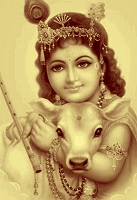
Lips are sweet. The face is sweet.
|
||
|
वचनं मधुरं चरितं मधुरम्
|
vacanaṃ madhuraṃ caritaṃ madhuram
|
|
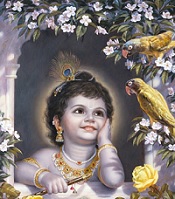
The speech is sweet. The character is sweet.
|
||
|
वेणुर्मधुरो रेणुर्मधुरः
|
veṇurmadhuro reṇurmadhuraḥ
|
|
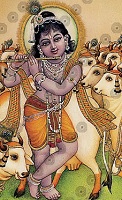
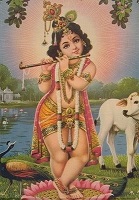
The flute is sweet. The dust is sweet.
|
||
|
गीतं मधुरं पीतं मधुरम्
|
gītaṃ madhuraṃ pītaṃ madhuram
|
|
The song is sweet. The drink is sweet.
|
||
|
करणं मधुरं तरणं मधुरम्
|
karaṇaṃ madhuraṃ taraṇaṃ madhuram
|
|
The action is sweet. The crossing is sweet.
|
||
|
गुंजा मधुरा माला मधुरा
|
guṃjā madhurā mālā madhurā
|
|
The berry is sweet. The garland is sweet.
|
||
|
गोपी मधुरा लीला मधुरा
|
gopī madhurā līlā madhurā
|
|
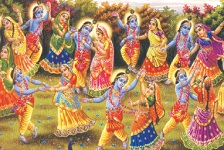
The cowherd women are sweet. The play is sweet.
|
||
|
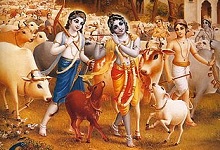
गोपा मधुरा गावो मधुराः
|
gopā madhurā gāvo madhurāḥ
|
|
The cowherds are sweet. The cows are sweet.
|
||
|
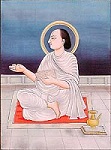
इति श्री वल्लभाचार्यकृतम् मधुराष्टकम् सम्पूर्णम् |
iti śrī vallabhācāryakṛtam madhurāṣṭakam sampūrṇam |
|
Thus ends the Sweet Cluster of Eight ślokas that was composed by śrī vallabhācārya |
||